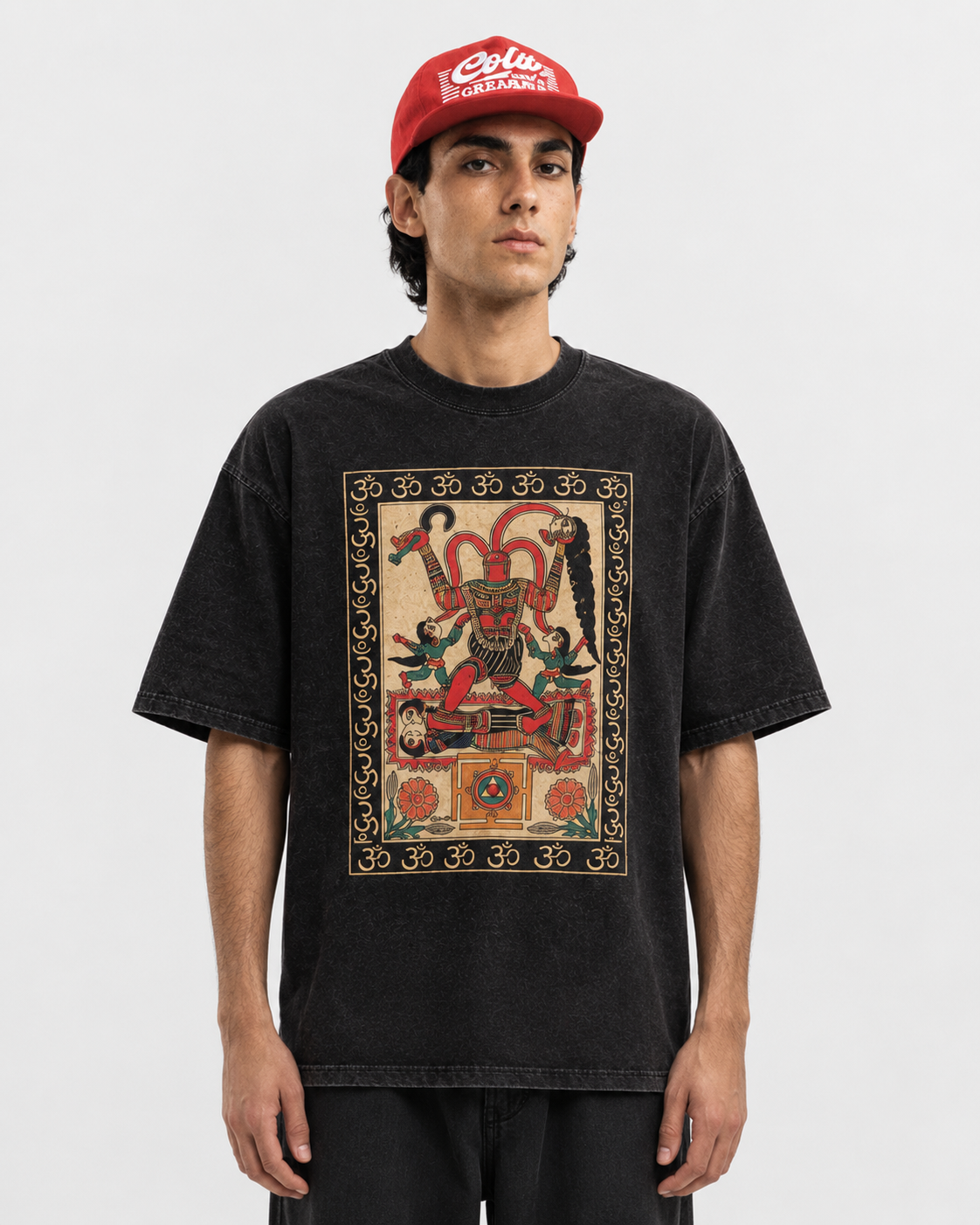
THE STORY Chinnamasta. The goddess who gave her head.
Share
Few images in Indian art stop you as fast as Chinnamasta. A goddess stands holding her own severed head, three streams of blood rising from her neck. It looks like horror at first. Look longer and it reads as something else: a picture of sacrifice, hunger and what it takes to let go of the self.
01 / WHO SHE ISOne of the ten Mahavidyas
Chinnamasta, also written Chhinnamasta or Chinnamastā, means "she whose head is severed." She is one of the ten Mahavidyas, the "great wisdom" goddesses of the Tantric tradition, alongside Kali, Tara, Bhuvaneshvari and others. She is also known as Prachanda Chandika, the fierce one.
The Mahavidyas are not gentle figures. Each one shows a different face of the divine feminine, and many of them deal with the parts of life people prefer to look away from. Chinnamasta stands for sacrifice, and for the cycle of life, death and renewal that feeds everything.
02 / THE LEGENDThe river and the hungry
The best-known story comes from the Tantric texts. The goddess Parvati went to bathe in the river Mandakini with her two attendants. After the bath, the attendants grew hungry and asked her for food. She asked them to wait. They kept asking, and said they were starving.
In reply, Parvati took a blade and cut off her own head. Three streams of blood rose from her neck. One flowed into her own mouth, and the other two fed her attendants. The goddess had given everything she had to feed those who depended on her.
Versions of the story differ between texts and regions. Some tell it differently, but the heart is the same: a sacrifice made out of care, and a life that keeps going.
03 / READING THE IMAGEWhat everything means
Almost every part of the painting carries meaning. Here are the main ones, as they are commonly read:
The severed head
Letting go of the ego and the idea that you are only your body.
Three streams
Life flowing out and nourishing others. Some traditions also read them as three channels of energy in the body.
The two attendants
Dakini and Varnini, the ones she feeds. They stand for hunger, and for the energy that keeps the world moving.
The couple below
She stands on a couple, usually named Kama and Rati. This shows desire held under her feet, and a mind that is not ruled by it.
Her garland of skulls and the serpent she wears also appear in many pictures of her. Together they stress that death and desire are part of the same cycle, not its opposite.
She isn't about destruction. She is about what you are willing to give.
04 / WHERE SHE IS WORSHIPPEDTemples and traditions
Chinnamasta is worshipped mainly in Tantric traditions across eastern India and Nepal. The Chhinnamasta temple at Rajrappa in Jharkhand is among her best-known shrines. Chintpurni in Himachal Pradesh is also associated with her. Mithila, the region of Bihar where Madhubani painting began, has a strong Tantric heritage, and the Mahavidyas are a familiar subject in its folk art.
05 / WHY SHE'S ON THE TEEFrom the wall to the chest
For this drop we painted her in the Madhubani style, with bold outlines, a border of Om symbols and marigolds in the corners, and a yantra at the base. We wanted the piece to look like a painting you could hang, and then we put it on a black oversized tee.
We make streetwear for people who aren't afraid to wear something different. Chinnamasta is one of the least comfortable images in Indian art, and that is exactly why it's worth wearing and talking about.
This is a short introduction, not a scholarly one. Stories and meanings of Chinnamasta vary between traditions, texts and regions, and devotees of the goddess understand her in many ways. We have tried to describe her with respect.